Biology


Murder in the Nest

Things are a bit cuckoo in this part of birdland:

Cuckoos live what seem to be lives full of deception and murder. As adults, they lay their eggs in the nests of other birds. (Why raise your own chick, when you can dupe others into doing the work for you?)
Cuckoos typically hatch only one offspring at a time. And when they do, the interlopers promptly push the other eggs out of the nest, killing the host birds’ true offspring.
For the newborn cuckoo, masquerading as multiple chicks can be difficult, especially when the lone, giant nestling replaces the usual clamoring brood.

Do any human analogues to this behavior come to mind?

Keeping Abreast of Avian Flu

Tyler Cowan of Marginal Revolution has started a new blog: Avian Flu – What we need to know. Its mission:

We at avianflu.typepad.com are committed to the idea that decentralized communication and expertise can make a difference. We have set up this blog as a clearinghouse for information about avian flu. Sadly avian flu may become a major crisis, so the world should have all of the defensive resources at its disposal, including blogs.
If you have a relevant post for the blog, please let us know. Please feel encouraged to leave your ideas and expertise in the comments section of the relevant post. There is much information about avian flu that is not available in the major media or on-line. Comments from individuals in affected areas, and research scientists, are especially welcome.
We do not necessarily endorse or agree with the contents of linked material. Nor do we intend this blog as a source of medical advice. Our mission is that of a clearinghouse and communication center.

Cowan notes:

It’s odd to start a blog that you hope nobody reads, but that is what this is.

And I hope this turns out to be a very uninteresting subject. In the meantime I’m linking the site and adding it to my RSS feed.


Tangled Bank #24

Tangled Bank #24 is up at Syaffolee:

There’s everything from visual perception to DNA repair and evolution to salamanders. The sheer variety of science articles and links surely live up to this weblog carnival’s title.

Yep, lots of good, interesting material!


Seabird Skulls and Bones

Bird lovers, biologists, and the curious will find these skulls, bones, and accompanying text fascinating:

Seabirds live in a complicated world. They have to cope with very different situations: flying in all types of weather, walking on land, swimming in the water, digging burrows, diving under water etc. Seabirds also have to deal with a myriad of prey and food types. No wonder they developed a wide range of foraging techniques tuned to their main source of food: from the small zooplankton to dead whales. No wonder that there exist a great variety of seabirds with a likewise great variety of adaptations.
All of these adaptations are reflected by the built of the skeleton. Although the parts are treated separately, their form and function can only be understood by looking at the whole picture: the morphology of the bird in relation to is environment, its adaptations, its foraging strategies etc.

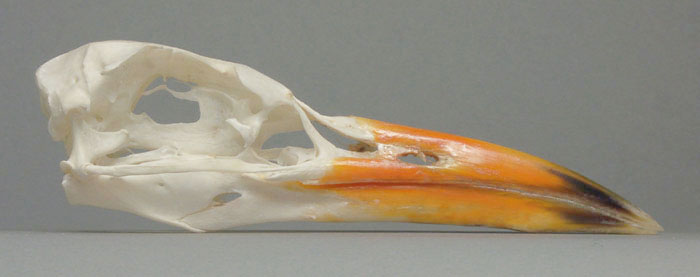
Here is the skull of a Caspian Tern:
Sterna caspia.JPG
Via Boing Boing.