Catching up on Genetic Dispositions
Well, by mistake I decided to read Kristoff’s column from yesterday:
Instead, modern science is turning up a possible reason why the religious right is flourishing and secular liberals aren’t: instinct. It turns out that our DNA may predispose humans toward religious faith.Via previous education I knew just where to look for the antidote to this stuff and Myers was P.Z. on the spot:
It�s nothing but modern molecular preformationism. Palmistry for the genome. We�ve been fighting against this simplistic notion of the whole of the organism prefigured in a plan or in toto in the embryo since Socrates, and it keeps coming back. We�ve moved from imagining a little homunculus lurking in the sperm to one hiding in the genome. It�s just not there. You can�t point to a spot on a chromosome and say, �there�s the little guy�s finger!�, nor can you point to a spot and say, �there�s his fondness for football!�.It won’t hurt you to read the rest of the post yourself…
Kristof, for instance, points to a particular gene as the source of piety. Piffle. Here�s his shining locus of sacredness, VMAT2:
Over at Crooked Timber John Quiggen provides additional curative resources by working through some statistical, logical, and definitional failings in Kristoff’s piece and more generally with pop evolutionary psychology.
As usual the comment threads to both posts provided plenty of stimuli for both my chuckle gene and my thinking gene.
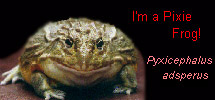 The African bullfrog, or Pixie frog as it is often called (because of it’s latin name, not because it’s as cute as a fairy!), is one of the largest frogs in South Africa. Usually, they hang out in open grassland, and if there are any to be found, they’ll sit around in puddles. When startled, these frogs will blow up like balloons to scare away the intruder! In the dry season, they will burrow into the ground. These guys eat lots and lots of really big bugs, fish, mice, lizards, and even other frogs.